A Country in Hell: Why the War in Sudan Has Already Lost Its Purpose, but the Unbridled Violence Has Not
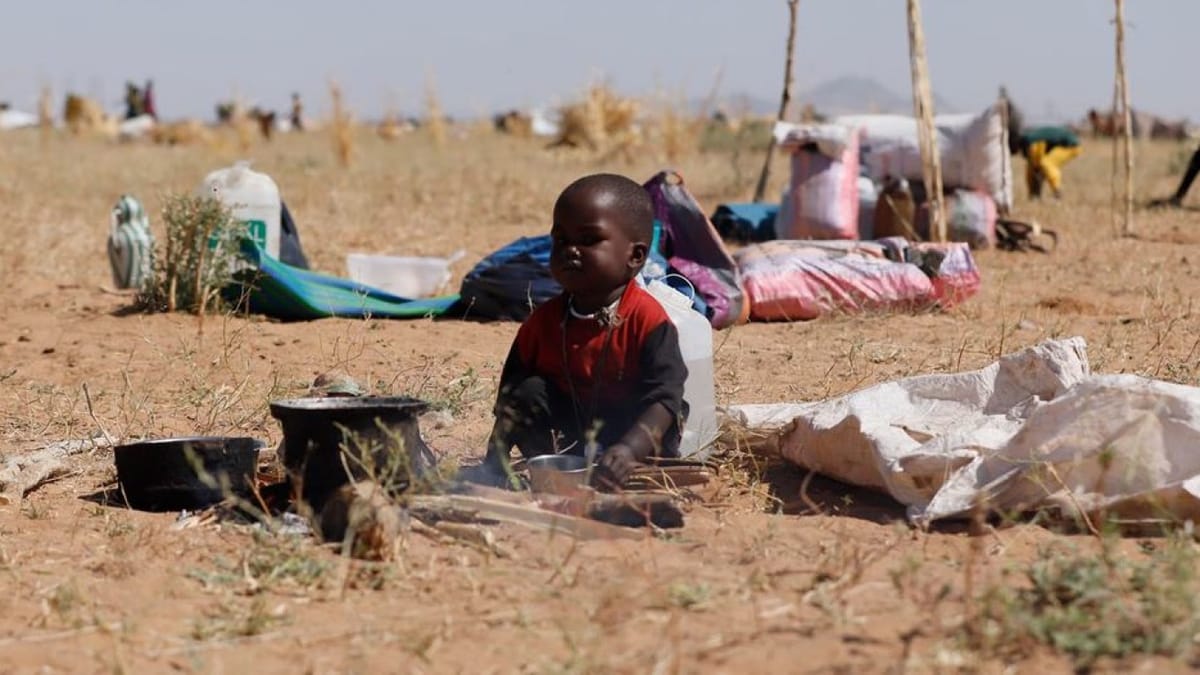
El Fasher has fallen. The last major city in Darfur (a region in western Sudan) that remained under government control has been captured by the paramilitary rebel movement RSF, the so-called Rapid Support Forces. In El Fasher itself, there is now no communication, no medicine, no drinking water, and no food.
The air above the charred ruins of houses is shrouded in thick smoke from fires. Random gunfire can still be heard in the destroyed neighborhoods. The streets are deserted, but entire families are still hiding in basements, with nowhere to go. And even if there were, why would there be? For hundreds of kilometers around, it's the same endless and merciless civil war.
The weeks-long siege of the North Darfur state capital finally ended with a storming of the city and its capture. But it's hardly worth calling that liberation. The RSF thugs have proven to be no better than their opponents – the government forces. International humanitarian organizations cannot enter the city, so the UN has not published any reports for several weeks. Everything happening now in El Fasher is hidden by thick plumes of black smoke.
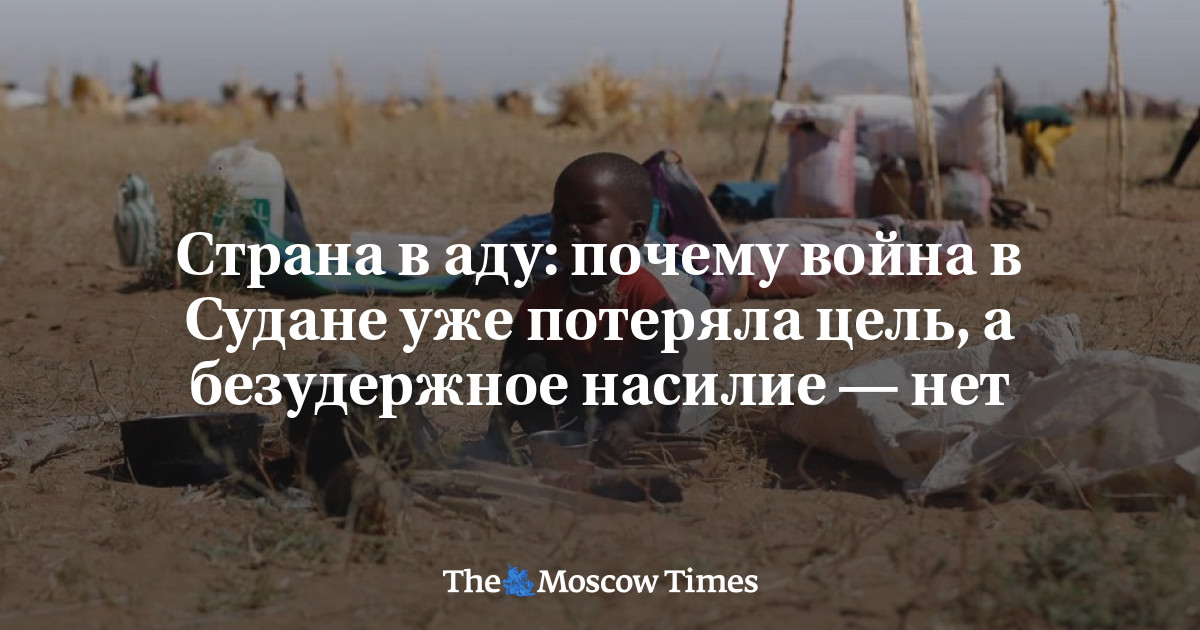
The capture of El Fasher is not an ordinary event in the brutal chronicle of recent Sudanese turmoil. With his fall, perhaps the last hope for the country's return to a generally understood normality collapsed. Until recently, this city remained a kind of island of safety and relatively peaceful life in the raging ocean of the Sudanese civil war. By chance, the heaviest fighting had previously bypassed him, causing no serious damage. Hospitals continued to operate there, and humanitarian aid warehouses were located there. Tens of thousands of people fleeing the fighting also flocked there and were crammed together for a long time. Many of them had no housing there, not even rented. Fortunately, the climate of the hottest and driest country on the planet is quite suitable for locals to sleep directly on the ground under the open sky.
The fall of El Fasher was seen by many experts as a death sentence for the entire regional security system in Northeast Africa. There are now absolutely no neutral territories left in Sudan. This means that from now on, there are no safe places left to survive in the entire country torn apart by civil war, which was recently the largest on the continent, without taking up arms on the side of one of the warring factions. And this will undoubtedly only exacerbate the bloody conflict.
The civil war in Sudan will soon be three years old. In April 2023, the country's regular army (SAF), led by General Abdel Fattah al-Burhan, and the paramilitary Rapid Support Forces (RSF), commanded by Mohamed Hamdan Dagalo, known as Hemedti, entered into open armed conflict with each other. (We wrote more about this here.) The closest analogy to those events for a Russian reader would be, for example, a direct clash between the Putin-backed Russian army and, for example, an alliance of various private military companies under the overall command of a hypothetical Prigozhin. Sudan was slowly but steadily falling apart at the seams, quite literally.
I wouldn't call the capture of El Fasher by Hamidi's rebels a strategic turning point in the Sudanese bloody epic as such. The significance of this event lies in a completely different dimension. It didn't so much change the military balance of power (although it's hard to deny the severity of al-Burhan's troops' defeat, at least in this particular episode) as it showed with unprecedented clarity that this war cannot be ended in the usual way – with a decisive victory over the enemy. Both camps are demonstrating a complete inability to defeat their opponent, establish firm control over the entire territory of the country, and are clearly prepared to continue the bloodshed until their last fighter.
The infamous international community – perpetually fragmented, preoccupied with petty political maneuvering, and routinely expressing endless concerns – still prefers to ignore the Sudanese tragedy. This is the traditional reaction of all countries when Arabs are exterminated not by Jews, but by other Arabs. And, of course, everyone, as always, doesn't care that hundreds of times more people are dying there than, for example, in Palestine. Unlike the latter, the interest of Western media in Sudan is not paid for by billions of petrodollars from the monarchs of the Arab Gulf countries. Therefore, for me personally, as someone who has worked in Sudan for over four years and has come to love this African country deeply, the tragic story of El Fasher is a litmus test, showing how far the world is willing to go in hypocrisy and indifference.
"Harbingers of Genocide": Words Instead of Actions
For the past three months, since the beginning of August 2025, El Fasher has been under a tight siege organized by the RSF. It was the last major city in the east of the country still held by government (predominantly Arab) armed forces and allied local volunteer groups – mainly from the Masalit African ethnic group. For international humanitarian missions, it remained the "road of life" in the region. More than half a million civilians and internally displaced persons were also crowded there. Many of them have already been thru the meat grinder of mass killings, rapes, torture, and ethnic and religious cleansing perpetrated by fighters of the Arab nationalist movement "Janjaweed" (the predecessor of the RSF).
The siege of the city began with the traditional African tactic of cutting off the few roads and blocking the rare water sources in the desert. Then came the predictable strikes on the suburbs, rocket attacks, and an offensive on key points: the radio station, local government buildings, and medical facilities. According to reports from international humanitarian organizations and human rights groups, RSF fighters finally broke into the city center in mid-October 2025. Their offensive was, of course, accompanied by mass killings, the rape of women and girls, unjustified destruction of homes, arson, looting, and cattle rustling. Amnesty International and Human Rights Watch have also documented eyewitness accounts of extrajudicial executions, kidnappings, and the destruction of entire residential neighborhoods.
The main hospital in the South Darfur region has literally ceased to exist. The building was completely destroyed during the rebel attack, and its staff were simply slaughtered. The few surviving doctors, abandoning their operating tables and patients, fled as best they could – on random passing trucks and carts pulled by camels or donkeys. The International Committee of the Red Cross has officially withdrawn its operations from the city due to a direct threat to its personnel.
In total, more than 70,000 people attempted to escape from El Fasher. They were moving in different directions, but predominantly westwards toward Chad. However, all escape routes were already controlled by RSF units, who were shooting people on the spot.
The significance of El Fasher's fall lies not so much in the scale of the violence that prevailed in and around the city, but rather in its distinctly ethnic character. The overwhelming majority of those killed and missing are members of the indigenous black population from the African tribes of the Masalit, Fur, Tunjuur, and others. According to the UN, their killings by Arabs are not random or episodic, but are absolutely systematic and planned. In their form, these "clashes" are closer to genocide than to combat. In some UN Office for the Coordination of Humanitarian Affairs documents, the phrase "precursors to genocide" was even used directly.
Unfortunately, this phrase is currently the only reaction from the international community to the events in Sudan. The entire modern world, including the UN Security Council, was unable to agree on anything more serious. So far, no resolution has been adopted that unequivocally and collectively condemns what is happening. The Russian delegation urged against rushing to accusations before a "fact-check," while the Chinese delegation called for avoiding "politicized assessments." The United States and the United Kingdom expressed "serious concern," while France expressed "deep alarm." At the very moment when the prim diplomats were slowly and deliberately uttering these words from the high podiums of the UN in New York, El Fasher, along with its inhabitants, was literally being wiped off the face of the earth.
The state is gone: Who controls Sudan today?
The fall of El Fasher is noteworthy not only because of the scale of the atrocities. As cynical as it may sound, a large portion of the Sudanese population has been subjected to exactly the same brutality regularly over the past few years. And it didn't cause any particular emotions in anyone in the world. The resonant events of the hot autumn of 2025 will undoubtedly go down in the tragic history of Sudan, more likely as a watershed, finally solidifying the disintegration of a country that, although mired in civil war, was still relatively united, into a "patchwork quilt" of clan influence zones. The former administrative boundaries drawn by officers of the British colonial army have now completely lost all meaning. Thus, as of the end of 2025, the territory of what is likely the former Sudan looks roughly like this.
In the east of the country, along the Red Sea coast (Port Sudan, Atbara, etc.), there is a territory controlled by the regular army (SAF). It is ruled by the head of Sudan's official (i.e., formerly legitimate) government, General Abdel Fattah al-Burhan. The few remaining former state structures are barely functioning here. Foreign policy is being implemented, financial instruments are functioning, and the infrastructure of maritime trade is being maintained, albeit with difficulty. However, even in this stronghold of former statehood, the army's capabilities are severely limited. Large areas of some states are controlled by warlords or tribal unions. Many of them often act according to their own logic and are not always inclined to obey orders from the conventionally understood "center," which has now shifted to Port Sudan after the fall of the former capital, Khartoum.
The western part of the country (primarily the large regions of Darfur and Kordofan) is now almost entirely under the control of the RSF rebels after the fall of El Fasher. This is no longer just territory captured by militants, but a slowly forming quasi-state. Their leader, Hamidti, now also has his own, albeit still primitive, tax service, food distribution system, armed patrols on the roads, and established supply routes for weapons and fuel across the border with Chad. A significant number of local officials switched sides and joined him. In parts of Darfur, entire regional and tribal alliances have also publicly pledged allegiance to the RSF. For example, in El Geneina, Nyala, and several other major cities, it is the RSF who are currently appointing their representatives to administrative positions, controlling the media, and even establishing their own judicial bodies.
The center and north of the country have become a "gray zone" – a space of complete uncertainty. Fighting there is going on with varying degrees of success. Weak fronts appear and spread out in different directions here and there just as suddenly as they unexpectedly collapse.
Khartoum (the former capital of the country) has been almost completely destroyed since the spring of 2023. Now it's essentially just one of many abandoned cities whose territory is completely uncontrolled by either side. The few remaining local residents there are barely surviving in the ruins of the former capital's neighborhoods without food and drinking water, without electricity and communication, without medical care and sanitation. The central government's influence here exists on paper and is manifested solely in the form of rare airstrikes and shelling by the regular army.
Thus, the territory of the former Sudan is now divided into at least three main parts. Two of them vaguely resemble independent states at odds with each other. The third is a buffer zone, within which the final border will most likely be drawn along the line of contact sooner or later. This is the most likely outcome of the current civil war: neither side is clearly able to achieve a military victory today, but each is rapidly consolidating its position in its "own" territory. All of this already resembles not an intense maneuvering civil war, but a frozen split with the beginnings of a stable internal border.
However, this doesn't stop both sides from claiming sole rights to the entire territory of Sudan. Al-Burhan, who doesn't even control his former capital, justifies his legitimacy by claiming he is acting on behalf of a state formally recognized on the international stage. His opponent, Hamidti, who has never held a government position, prefers to speak on behalf of the revolution he never brought to completion. But all their statements are directed solely outwards. Dialog with each other is taboo for both, and compromise is synonymous with defeat.
In this atmosphere, on the thousand-year-old sands of the former Nubian kingdom, a new post-Sudanese statehood is taking shape. Of course, there is no formal document about the country's division yet, and no lines have been drawn on maps that are recognized by external players. However, a different, invisible geography of power is already being felt. And in these new circumstances, belonging to the former Sudan – which gained independence from Britain way back in 1956 – is rapidly ceasing to be a significant factor in citizens' self-identification. Today, for many of them, it's already more familiar and understandable to consider themselves supporters of al-Burhan or Hamidi.
Humanitarian Deadlock: Why Aid Isn't Reaching Those in Need?
Despite its near absence from the pages and airwaves of the world media, the humanitarian catastrophe in Sudan has surpassed all regional crises of the 21st century in terms of scale and severity of consequences. According to estimates from the UN Office for the Coordination of Humanitarian Affairs, more than 12 million Sudanese have been forced to leave their homes. About 5 million of them managed to flee abroad and find refuge in neighboring countries – primarily in Chad and South Sudan. However, international observers note that refugees are rather unwelcome there – the host countries themselves are running out of water, medicine, and the patience of local communities.
The majority of Sudanese displaced from their homes – over 7 million people – are wandering within the territories of their former homeland as internally displaced persons (IDPs), without access to medical care, food, or even basic sanitation. All mechanisms for any international humanitarian support in Sudan have long since collapsed. World Food Program (WFP) convoys are no longer reaching high-risk areas – key routes are blocked by militants and under fire. According to estimates by the United Nations Children's Fund (UNICEF), more than 3 million children in Darfur alone remain on the brink of starvation – regular food supplies stopped last summer. UN offices and warehouses in El Fasher and Nyala were attacked, destroyed, or looted. In the vast majority of episodes, the actions of RSF militants were discussed.
The main obstacle to continuing humanitarian activities in Sudan is the inability to agree on safe access to affected people and areas with both sides of the conflict simultaneously. The RSF refuses to provide security guaranties even under the umbrella of international missions: the militants consider them their enemies as well. The SAF suspects humanitarian organizations of sympathizing with the enemy and therefore also does not issue passes to the relevant areas. In the past period of 2025 alone, at least 27 cases of humanitarian trucks being stopped or robbed have been documented. In most episodes, the drivers were killed.
As a result, by the fall of 2025, all missions of international organizations that were previously working in Sudan will either be frozen or transitioned to a remote presence mode. The Red Cross has effectively ceased operations in all western states. Médecins Sans Frontières (MSF) has openly admitted that it is no longer possible to support clinics without putting their own staff at mortal risk. Last September, before the fall of El Fasher, the World Health Organization reported that over 70% of healthcare facilities in Sudan had been destroyed or were non-functional.
Cholera, malaria, dysentery, etc., are breaking out everyplace. Record increases in child mortality are being observed in IDP camps outside of Darfur. According to the NGO Save the Children, around 40% of Sudanese children suffer from acute malnutrition. Food supplies are almost completely depleted. The domestic market is paralyzed – roads are destroyed, supply chains are broken.
Since the Sudanese state lost its administrative functions and the war definitively entered a phase of mutual retaliatory operations, the humanitarian issue has become firmly embedded in military logic. Helping people condemned to death has ceased to be a neutral humanitarian mission and has become one of many tools of pressure on the enemy. Each side very quickly learned to use humanitarian aid as an element of military logistics, rather than as a means of saving people.
Therefore, today's Sudan is not just a territory of humanitarian disaster. It's a natural hell on earth – a zone of endless violence where even the possibility of humanitarian intervention and basic compassion is blocked, with the complete indifference of the outside world.
Geopolitical Inaction: Why the UN Has Written Off an Entire Country
Beyond Sudan's borders, there is still a full set of institutions, declarations, response mechanisms, and other completely useless diplomatic fluff. On papers with the UN logo, there is absolutely everything needed for a supposed complete resolution of the conflict. In practice, however, the Sudanese themselves have nothing.
As the war between the RSF and the SAF sucked in new regions at the speed of an industrial vacuum cleaner, destroying the last vestiges of normal life in an already impoverished country, no global power was able, and most importantly, unwilling, to take on the role of peacemaker. In this regard, the Sudanese are much less fortunate than, say, the Ukrainians or Palestinians, whose problems the whole world is concerned with today. The territory of present-day Sudan (even after the southern part of the country seceded in 2011) is more than 3 times larger than the combined territories of Ukraine and Palestine, and its population (based on pre-war levels) exceeds the total number of Ukrainians and Palestinians in the world by more than 6%. It must be acknowledged that both the UN and the entire global humanitarian support system are clearly experiencing a severe crisis of objectivity in setting priorities today. The problem with our world is clearly not a lack of aid tools, but an excess of what world leaders subjectively understand as "cold calculation."
Since the beginning of 2024, the UN Security Council seems to have entered a state of "managed paralysis." All attempts to adopt any kind of tough resolution on Sudan – demanding a cessation of hostilities, imposing personal sanctions on field commanders, calling for the deployment of peacekeepers – failed without exception. Russia, using its veto power, has consistently blocked all initiatives, calling them "interference in internal affairs," citing "state sovereignty" and the need for "national dialogue." China has almost always abstained, not too diligently masking its intransigence under the guise of supposed caution in decision-making. Western states last introduced a draft resolution calling for an "immediate cessation of violence in Darfur" and the opening of a humanitarian corridor to the most affected regions of Sudan in October 2025. This document, like all previous ones before it, has been blocked by Russia, China, and their allies.
Seeing the Security Council's inability to even take formal and symbolic steps, the US and the EU launched their usual set of targeted sanctions against both conflicting parties: personal travel restrictions, asset freezes, and arms embargoes. However, these sanctions predictably did not become real levers of influence on the situation. Neither the country's formal government nor Hamidti's rebels have been dependent on Western supplies for a long time, hold no assets in European or American banks, and have no significant ties to the governments of developed civilized countries. They simply have nothing to blackmail them with. And the standard set of statements we are all too familiar with, such as "deep concern," "extreme alarm," "the violence must be stopped immediately," etc., coming from Washington and European capitals, is perceived by Sudanese people as "white noise" and changes absolutely nothing.
However, the specific actions of regional players have a very noticeable impact on the configuration of the war. According to investigations and UN reports, the United Arab Emirates continued to supply the RSF with equipment and fuel thru logistics hubs in Chad in 2024–2025. Egypt openly supports the SAF, providing it with political cover and, according to some reports, even military advisors. Iran is also involved in supplying drones to al-Burhan's army. Turkey and Saudi Arabia are primarily trying to share the role of mediator, but they are not showing a willingness to exert serious pressure on either side.
Russia's role is a separate chapter in this war. Since the time of Omar al-Bashir (the former Sudanese dictator overthrown in 2019, whose close associate Hamidi was), Moscow has been building close informal contacts with the RSF, receiving access to Darfur gold in return. This work was carried out thru structures linked to the Wagner PMC (we wrote about this in detail here). Following Prigozhin's death in August 2023 and a reevaluation of approaches to the African direction, the Kremlin shifted its focus – Putin's priority became al-Burhan. Since then, Russia has supported the regular army – diplomatically, logistically, and economically. In September 2025, a series of agreements were signed with Sudan in Moscow regarding mineral extraction, the development of transport infrastructure, and participation in projects on the Red Sea. All of this clearly signals that the Kremlin is counting on the post-war loyalty of al-Burhan's regime and is already investing in its survival.
However, portraying Russia as the main beneficiary of the civil war in Sudan or exaggerating its influence on the situation in that country would be a nearsighted simplification. Moscow only filled a niche that others had vacated. In a situation where no global power is showing any willingness to engage with Sudan or interest in cooperating with it, Putin's strengthening of his position there, having already become as much an outcast on the world stage as al-Burhan or Hemedti, is more of a symptom than the root cause. As for influential global players like the US, EU, China, etc., Sudan remains a clearly secondary direction for them as a state (or rather, its remnants) without its own strategic weight or any tangible investment prospects.
A very telling illustration of the true prospects for cooperation with Sudan was the story of the Russian naval base on the Red Sea. In February 2025, the Foreign Minister in al-Burhan's government, Ali Youssef Ahmad al-Sharif, stated during a meeting with Sergei Lavrov in Moscow that the parties had reached a final agreement on the Russian base in Port Sudan and that all obstacles to the implementation of this project had now been removed (we wrote about this in detail here). However, as early as November 10, the Russian Ambassador to Sudan, Andrei Chernovol, was forced to publicly admit that due to the armed conflict in the country, no work on the base has been undertaken by anyone to date and that "any movement on this issue has been suspended." Thus, the "triumphant" return of the Russian Navy to the world ocean turned out to be nothing more than another information and diplomatic mirage.
Self-replicating Process
What is happening in Sudan can no longer be described as a conventional civil war in the way we are used to understanding it. The capture of El Fasher clearly showed that armed violence in the lawless territories south of Egypt has ceased to be a tool for achieving political or military goals and has definitively turned into a closed, self-perpetuating process. The previous talk about power-sharing, a transitional government, elections, national dialog, and other forms of settlement is no longer about this reality. Now it only has two large armed groups that have torn their country apart and are trying to maintain control over its bleeding remnants. And between them, like in millstones, the fates of millions of people are ground daily, deprived of all rights and even the illusion of a better future.
What Sudan shares with hell is not only the scorching heat and the unbearable suffering of its inhabitants. The tragedy of this country is all the more terrible because it is happening so quietly. Like from a real hell, no screams or shouts reach us from there. You won't find hours-long telethons dedicated to Sudan or strong calls from world leaders to immediately stop the violence on any channel in the world, including Arabic-speaking ones.
Thousands of Sudanese people continue to die silently and unnoticed. And the fall of El Fasher hasn't changed this situation at all.
 Сергей Коняшин