A Quarter of the World in the Crosshairs: Nuclear Escalation Without Restraint
The bloody terrorist attack in the city of Pahalgam, Kashmir, carried out on April 22 by militants from the "Resistance Front" and claiming 26 lives, has led to a sharp escalation in tensions between India and Pakistan. The long-simmering India-Pakistan conflict, familiar even from old Soviet songs, has flared up once again. But this time, traditional diplomatic demarches and sporadic artillery exchanges are not the end of it. Gunfire along the border is becoming increasingly frequent. Aggressive nuclear rhetoric is growing louder on both sides. Many existing channels of cooperation between the two countries are breaking down one after another. For the first time in decades, even the most fundamental bilateral agreements—previously resilient through multiple armed conflicts—are now under threat.
This unprecedented escalation is accelerating by the day and now appears dangerously close to spiraling into catastrophe. Among the potential scenarios is open warfare between two nuclear-armed nations that together account for nearly a quarter of the planet’s population. Any escalation there will inevitably extend far beyond Kashmir—and likely far beyond Eurasia.
Numerous external powers—from the United States to China, from Iran to the United Nations—are scrambling to prevent a disaster, fully aware of the global risks a nuclear war would pose. Yet the mutual, increasingly hardline rhetoric is rapidly narrowing the space for diplomacy. How far will this escalation go, and is there any hope left of avoiding a planetary-scale catastrophe by bringing the parties back to the negotiating table?
On the Brink of War
Two days after the Pahalgam terrorist attack, New Delhi announced the suspension of the 1960 Indus Waters Treaty—an agreement that for more than half a century had served as an untouchable framework for the allocation of water resources in the densely populated Indus River basin. The treaty, which had withstood the wars of 1965 and 1971, as well as the Kargil conflict in 1999, was considered one of the most stable international agreements between India and Pakistan. Islamabad, unsurprisingly, saw India’s move as an unprecedented act of aggression.
A harsh response followed swiftly. Pakistan announced the suspension of the 1972 Simla Agreement, which had defined the Line of Control in Kashmir—a disputed region between the two countries—and obliged both sides to resolve conflicts peacefully and solely on a bilateral basis. The collapse of this agreement effectively removes the last diplomatic barriers to an all-out war. Neither army is now restrained from trying to alter the status quo by force. What once seemed unthinkable throughout the modern era has become a looming reality.
On April 27, Indian Prime Minister Narendra Modi declared in a televised address to the nation that “those who orchestrated the attack will be punished... not a single terrorist involved will escape justice,” effectively signaling India’s willingness to strike targets on Pakistani territory. Islamabad, for its part, did not lag behind in raising the stakes. On April 29, Pakistan’s Defense Minister Khawaja Asif openly stated that the use of nuclear weapons against India was conceivable, warning: “If Pakistan’s existence is threatened... no one will survive.” Even against the backdrop of the bloody Russia-Ukraine war, these words struck an unprecedentedly chilling note—each side in the looming conflict possesses roughly 170 nuclear warheads. International experts are already sounding the alarm: the world now faces a scenario where the costs of further escalation are wholly disproportionate to any rational political objectives.
Meanwhile, tensions along the line of contact are rapidly escalating. As early as April 24—just two days after the attack—Pakistani troops opened fire on Indian border posts. India returned fire. Now, heavy exchanges of fire are reported almost daily. Both sides label the incidents “unprovoked attacks,” accusing each other of fueling the escalation. There have been confirmed reports of cross-border incursions—one Indian soldier was captured by Pakistani forces, and a few days later, a Pakistani soldier fell into Indian hands.
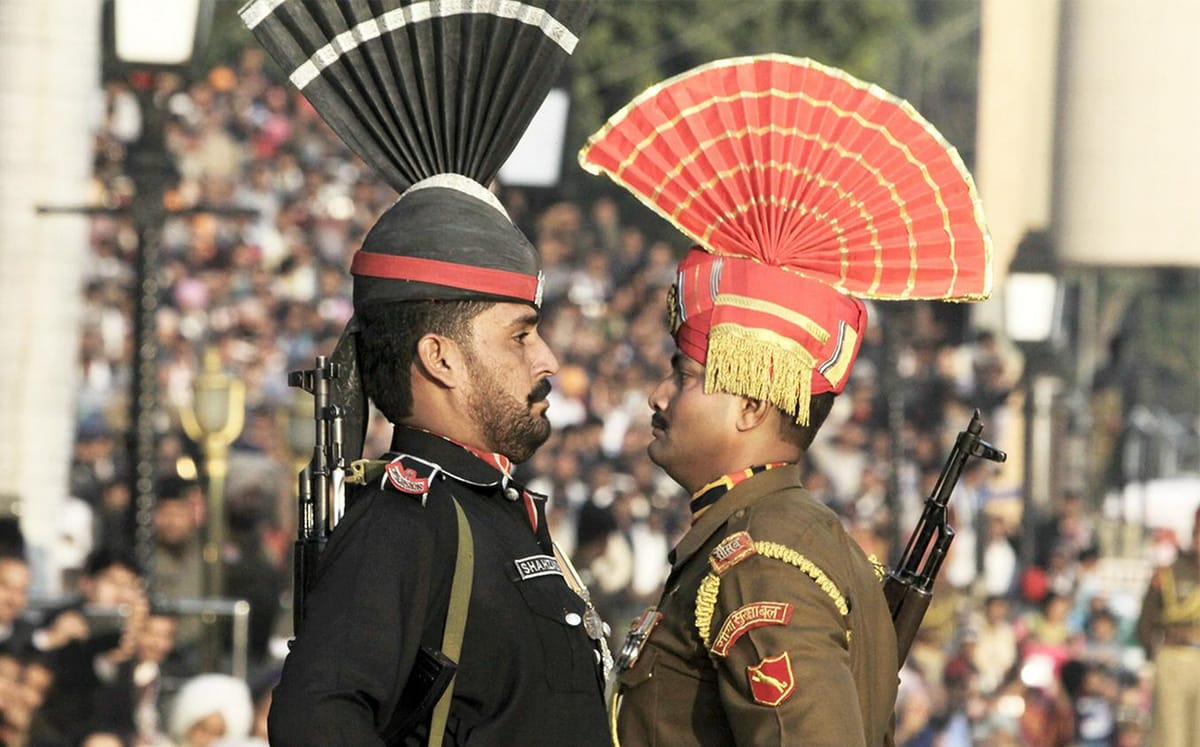
So far, there have been no fatalities, but the risk increases daily as traditional crisis communication channels between the two countries have all but collapsed. As of today, New Delhi and Islamabad have effectively dismantled all previous mechanisms for coordination and dialogue. India expelled Pakistani military attachés and recalled its own from Islamabad, reducing diplomatic contact to a minimum. In retaliation, Pakistan expelled Indian diplomats and closed its airspace to foreign aircraft. Even symbolically significant gestures rooted in Eastern etiquette—such as the daily handshake between border guards at the Attari and Wagah checkpoints on the only land route between the two countries—have been suspended.
Global SOS
The danger looming over South Asia has forced many global and regional actors to shift from passive observation to active engagement in an effort to prevent the worst-case scenario from unfolding. The UN Secretary-General publicly called on New Delhi and Islamabad to exercise maximum restraint and return to diplomatic dialogue as soon as possible.
The United States has taken a nuanced position. Washington strongly condemned the Pahalgam terrorist attack and affirmed India’s right to self-defense, but has thus far avoided directly blaming Pakistan. A State Department spokesperson noted that American diplomats are in contact with both governments at all levels and are urging them to seek a “responsible solution” to the current crisis. Washington’s caution is understandable. Both India and Pakistan are among the United States' closest and most important partners in the Indo-Pacific region, making the destabilization of either undesirable. Indirect signs suggest that the U.S. has opted for behind-the-scenes diplomacy. The core efforts are likely being conducted through intelligence and military channels, while public pressure—potentially counterproductive in the already highly charged atmosphere—is being deliberately kept to a minimum.
China also quickly called for de-escalation. Beijing expressed hope that both governments would act with restraint and welcomed any steps that might help “cool down the situation.” While China has long supported Pakistan (as a natural counterweight to India), a full-scale, potentially nuclear conflict near its own borders is not in Beijing’s interest. Moreover, around 10% of the former princely state of Kashmir—specifically the Aksai Chin region—is controlled by China itself. Further escalation thus carries a very real risk of drawing Beijing into the conflict as well. As a result, China’s leadership is trying to position itself as a moderate arbiter—condemning terrorism on one hand, while urging India not to escalate its military response on the other.
Iran took many observers by surprise by offering to mediate. Taking advantage of its working relationships with both Islamabad and New Delhi, Iranian diplomats publicly announced on April 25 their readiness to facilitate direct dialogue. Five days later, Iranian Foreign Minister Abbas Araghchi arrived in the Pakistani capital, calling on both sides “to show restraint and avoid heightening tensions,” emphasizing that Tehran “insists on de-escalation” and is prepared to assist with negotiations.
Russia, through Foreign Minister Sergey Lavrov, expressed deep concern and urged both India and Pakistan “to refrain from further escalation,” reiterating the usual talking point about the necessity of diplomatic solutions. Meanwhile, Pakistan opted not to limit its efforts to bilateral channels. Its representatives have already appealed to the United Nations, requesting a meeting of the Security Council to brief the global community on India’s “aggressive actions” and the potential threat to regional security.
The sharp uptick in engagement by so many external mediators underscores the scale of the looming threat. The stakes have long since moved beyond a simple territorial dispute between two nations. That’s why the international community is now ready to activate every tool available to prevent the South Asian crisis from approaching a perilous nuclear threshold.
Mobilizing Minds
The information space in both India and Pakistan has transformed into a full-fledged battlefield of its own. Officials and media outlets in both countries have adopted the language of ultimatums and mutual blame. In the wake of the "Pahalgam massacre," India has been swept by a wave of fury. Television channels and social media are demanding harsh retribution. The opposition is pressuring the government to show no signs of weakness. The hardline rhetoric, amplified by the media, has brought public sentiment to a boiling point. On April 25, Praveen Donthi of the International Crisis Group noted that “Modi is now under intense public pressure to take decisive action—even military.” In effect, the prime minister has cornered himself with his own promises.
Pakistan, for its part, is no less restrained in tone. State-run networks and popular talk shows repeatedly denounce Indian aggression and assert Islamabad’s right to respond. Even before any concrete action by the Indian military, senior Pakistani officials are warning of an impending attack and declaring the nation’s readiness to fight back. Every move by the adversary is framed as an existential threat. As soon as New Delhi announced the suspension of the water treaty, Pakistani media labeled it an “illegal act” and “the beginning of a water war.” Energy Minister Awais Leghari declared that “every drop of the Indus rightfully belongs to Pakistan, and we will defend that right by all means.” In such an environment, Islamabad’s leadership finds it just as difficult as Delhi’s to exercise restraint—any perceived softening of position now risks being immediately condemned as a betrayal of national interests.
The situation is further inflamed by the inevitable wave of wartime misinformation and disinformation campaigns on both sides. In India, dozens of fake social media accounts have been identified spreading provocative rumors and inciting hatred. Authorities have even blocked a number of Pakistan-linked channels on YouTube and Instagram, citing false reports and incitement. In Pakistan, fear is being stoked among the public through widespread circulation of unverified “leaks” about an imminent Indian assault. In a race to portray the other as the aggressor, both countries are waging an information war—on both domestic and international fronts. As often happens in times of mass hysteria, strict censorship and surges of patriotic rhetoric are rapidly silencing the more moderate voices calling for dialogue.
The Final Frontier
The optimistic scenario envisions that after this surge in tensions, New Delhi and Islamabad will eventually agree to step back. Pressure from Washington, Beijing, Tehran, and other mediators could, in theory, revive behind-the-scenes dialogue and open the door to an international investigation into the Pahalgam attack. Such an outcome is still possible. Most likely, neither Delhi nor Islamabad—despite their belligerent rhetoric—is truly prepared to pay the enormous price of war. However, the stakes have been raised so high that even a single miscalculation could prove fatal.
The opposing scenario—further escalation leading to open war—is no less plausible. Another major terrorist attack or a serious border incident with casualties could make public pressure on both governments overwhelming. In such a situation, India may feel compelled to carry out a “surgical” strike against militant camps on Pakistani soil. Prime Minister Modi’s government is believed to have several such options already prepared, which would not require large-scale troop deployment. Pakistan, in turn, would almost certainly respond with rocket attacks on Indian border installations or a limited ground offensive to seize new positions in Kashmir.
In their effort to “save face”—a defining motivation in the traditional Eastern ethos of conflict—both sides could push far beyond the point of no return. Especially considering that Pakistan’s nuclear doctrine formally allows for a first strike, even on its own territory. In the past, the understanding that any nuclear exchange would lead to mutual annihilation served as a powerful deterrent. But those were very different times, with very different leaders—and very different nations.
 Сергей Коняшин