The "Master of the East" and His Executioners, or The Peculiarities of Clan Warfare in Putin's Foreign Ministry
On 20 February 2026, two news items were published at once, both of which drew heightened attention from the diplomatic community. The first was the appointment of the influential Russian Arabist Sergey Vershinin as ambassador to Turkey. To begin with, this is a clear demotion: since 2018 Vershinin had served as Lavrov's deputy and had long outgrown an ambassadorial post. On top of that, Turkey is plainly not his area of expertise, and he will feel decidedly out of his depth there. It would have been far more logical for him to take the seat left vacant since the middle of last year by Mikhail Bogdanov — another well-known Russian Arabist, who in his day was responsible for precisely the Middle Eastern and African countries.
The second news item is that, on that very same day, the post left empty for so long by Mikhail Bogdanov was handed to Georgiy Borisenko, who had just completed his six-year tenure as Russia's ambassador to Egypt. But let us not be misled by this man's most recent posting. Before he came to Cairo in April 2020 to replace the professional career Arabist Sergey Kirpichenko, Borisenko had never had anything to do with the Middle East. Having graduated from MGIMO in 1990 with English and German, he spent his entire diplomatic career either in the United States or in the Department of North America, which handles it. In other words, it would have been hard to find a figure of suitable rank yet more remote from Middle Eastern discourse, and less involved in Arab and Islamic affairs, than Borisenko.
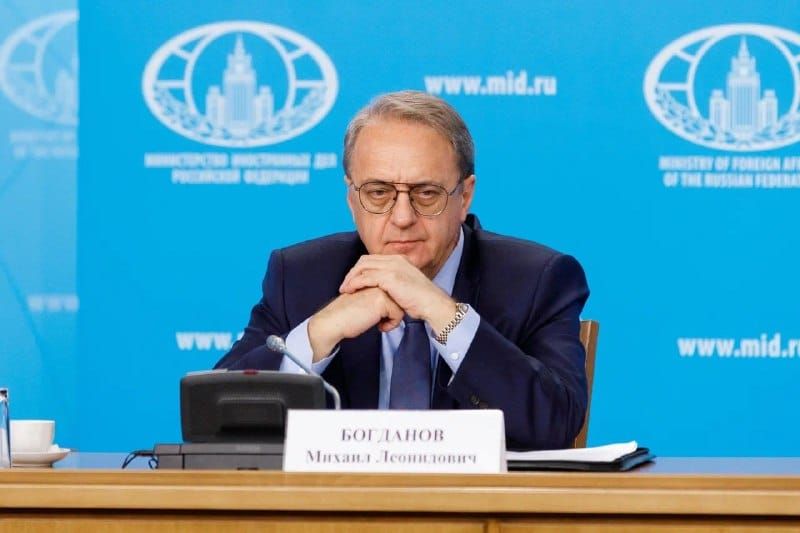
And all of this is unfolding against the backdrop of insider reports that the investigative status of Mikhail Bogdanov — the former deputy foreign minister of Russia, dismissed last year after the arrest of his closest aide — has changed from witness to suspect. This information comes from inside the system, from one of my sources, whose identity, for obvious reasons, I will not disclose. But if it is accurate, then we are looking at the first campaign of bureaucratic destruction at so senior a level in the recent history of the Russian Foreign Ministry. And the latest personnel decisions around the "Arab department" — in particular, the distancing from it of influential, high-ranking Arabists and the dilution of its leadership with outsiders — appear to point to a deliberate drive to weaken this unit and to drive the final nails into the coffin of the entire "Bogdanov legacy."
The Beginning of the End
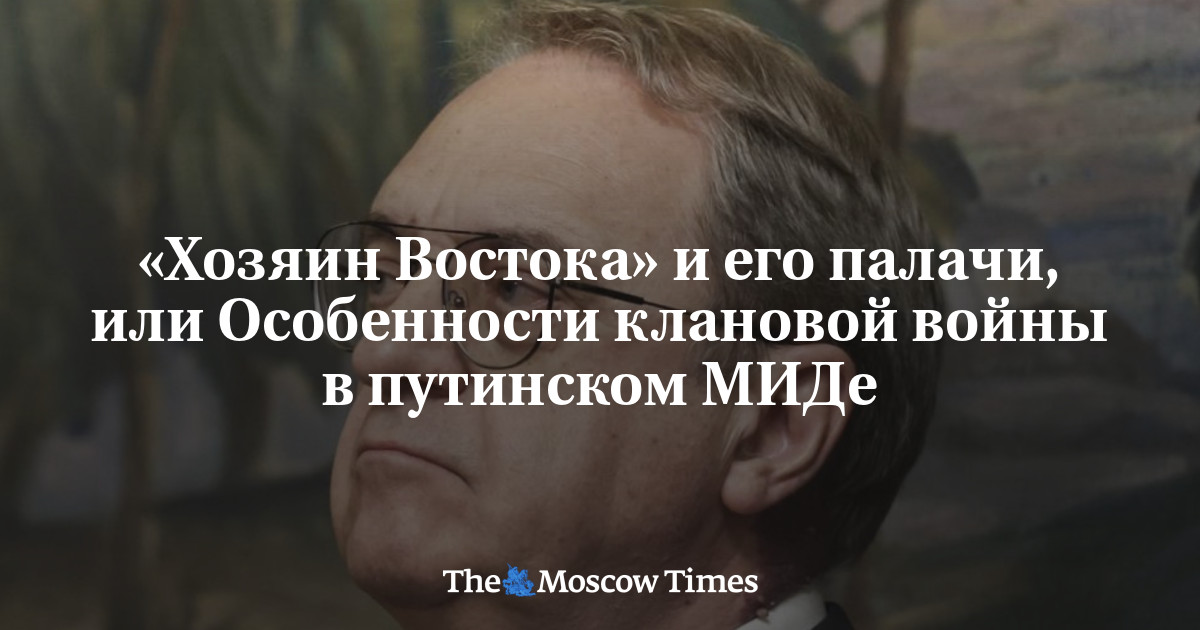
On 9 July 2025, to everyone's surprise, Mikhail Bogdanov was removed from his posts as deputy foreign minister and as the president's special representative for the Middle East and Africa. The formal reason was that he had supposedly reached retirement age. Nothing had foreshadowed the dismissal until the very last moment. The day before it, the "Master of the East" was still deciding which Russian PMCs would receive the best terms in Syria, whose oil interests would be better protected in Libya, who would be awarded the gold and diamond mines in Mali, Sudan and other Arab countries. Yet literally overnight he fell victim to the very system he had himself faithfully served for decades and which he had himself so diligently fortified.
Behind the formal retirement of a senior pensioner-diplomat lies, by all appearances, the first major purge of the foreign-policy bloc in modern Russia, on a scale approaching that of Stalin. Or else a clan war that has sharpened to a previously unprecedented degree, one in which the diplomatic elite has turned out to be the weak link.
Shortly before Bogdanov's dismissal, his closest aide was arrested — Vasiliy Kravchenko, first secretary of the Foreign Ministry's General Secretariat. All classified correspondence on the Middle Eastern and African tracks passed across this man's desk. According to a number of insider channels, Kravchenko was sent to the Lefortovo pretrial detention center (the FSB's main remand prison) on charges of high treason. The corridors of the Foreign Ministry's "Arab department" — the Department for the Middle East and North Africa (DMENA) — filled with fear. Senior staff began hastily going on leave. An unscheduled FSB inspection descended on the secretariat without warning. Mass seizures of documents began, along with the sealing of archives and the confiscation of computers, removable storage media and other office equipment.
The context of this story, however, is far broader than the dismissal of a single deputy minister on Smolenskaya Square (the seat of Russia's Foreign Ministry). In February 2026, in an assassination attempt in the entryway of a residential building on Volokolamskoye Highway in Moscow, Lieutenant General Vladimir Alekseev, first deputy head of the GRU, was gravely wounded. In his time, this man had played a key role in deploying and coordinating Putin's forces in Syria, after which he continued to wield considerable influence over the Russian military presence in that country in the interests of its recently overthrown dictator, Bashar al-Assad. According to the analytical conclusions of the well-known investigator Christo Grozev, the FSB was behind that attack as well.
This double blow by the security services against the Middle Eastern cluster of agencies — agencies that partly compete with them in this arena — does not look like a coincidence. More likely, it attests to an intensifying clan war over rapidly shrinking resources. The redivision of spheres of influence has evidently moved to a qualitatively new stage, one in which the various parts of Putin's system have begun to devour one another.
The Man Who Knew Everything
The biography of Vasiliy Kravchenko — a fine Arabist and a promising civil servant, the son of a well-known Africanist from academic circles — contained nothing unusual for a Russian diplomat: an excellent reputation, a steady career, no scandals. When the news of his arrest reached his colleagues, the general reaction was one of genuine astonishment.
At the time of his detention, Kravchenko held a post whose dull title would tell an outside observer little: first secretary of the General Secretariat (Department) of the Russian Foreign Ministry. A specimen of the clumsiest bureaucratese, and yet in essence one of the most sensitive positions in the entire Russian foreign-policy establishment. The General Secretariat is the nervous system of the Foreign Ministry. It is through this body that all internal correspondence passes, including documents bearing the highest classifications of secrecy.
Kravchenko was no ordinary functionary filling that staff slot. He was the most trusted aide of Mikhail Bogdanov personally — accompanying the deputy minister on his key trips abroad across Africa and the Middle East, attending the most confidential meetings, drafting classified documents, maintaining his communication with "the Center."
Kravchenko's functions did not end there. Alongside Bogdanov he also played another, unofficial role: managing his boss's informal financial flows. This work was conducted primarily through the structures of the Imperial Orthodox Palestine Society (IOPS). Vasiliy Kravchenko was thus a man who combined access to the most important state secrets with the role of financial operator for the shadow side of the entire Bogdanov diplomacy.
In late July 2025 it emerged that, following a working trip to South Africa, Kravchenko had vanished. He stopped appearing at the office, and his colleagues could not reach him by phone. A few days later, insider Telegram channels — VChK-OGPU (a play on the names of the early Soviet secret police), Kompromat Group and several others — reported that Kravchenko had been detained by the FSB and placed in the Lefortovo pretrial detention center. This is where defendants in the most high-profile cases against state security are usually held.
Among the charges brought against the diplomat was the transfer abroad of "top secret" information — Articles 275 (high treason) and 276 (espionage) of the Russian Criminal Code. To whom exactly this information was destined, through which channels it had leaked and to what end, was not specified. As of February 2026, no official procedural documents in the Kravchenko case are publicly available. The factual substance of the charges is being reconstructed by journalists from rare leaks on media outlets that specialize in insider material from the security agencies.
One version that flickered through several publications, and was quickly picked up by certain political commentators, perhaps deserves separate mention: the claim that Kravchenko's arrest was supposedly connected not to Middle Eastern matters but to the Ukrainian (!) negotiations, by way of his contacts with the circle around LDPR (Liberal Democratic Party of Russia) leader Leonid Slutsky, who took part in the Istanbul negotiation process that same year, in 2025.
In my view, this version does not stand up to scrutiny. Sources close to the investigation maintain that Kravchenko's contacts with people from Slutsky's orbit did indeed take place. But they concerned the Middle Eastern track exclusively — that is, the zone of direct responsibility of his boss, Bogdanov — and had nothing whatsoever to do with the Ukrainian track. I am convinced that the "Istanbul" version was noise put into circulation by the security men in order to divert attention from the real content of the Kravchenko case — among other things, to avoid spooking the bigger fish: Bogdanov himself, against whom his closest aide, under pressure from the FSB, could hardly fail to testify.
Business Above All Else
Bogdanov had held the post of deputy foreign minister since 2011. A career Arabist fluent in Arabic, he had passed through a long diplomatic schooling in the Middle East going back to Soviet times. His other post — special representative of the Russian president for the Middle East and Africa — gave him direct access to the Kremlin, bypassing the ministerial hierarchy. In this capacity Bogdanov was the principal channel of communication between Putin personally and Bashar al-Assad and the entire Syrian leadership, the Libyan marshal Khalifa Haftar, the leadership of the largest Shia groupings in Iraq and Lebanon, and the leaders and governments of virtually every country from the Maghreb to the Persian Gulf. For fourteen years he determined how Russia spoke to the entire Arab world — and how the Arab world spoke to Russia.
The official version of his dismissal — the end of a career on grounds of age — is formally impeccable. Bogdanov is indeed already well past seventy. A captious reader will, of course, easily count quite a few high-ranking officials in the ranks of Putin's nomenklatura who are older than Bogdanov — and will be entirely correct. It was not his venerable age that cost the "Master of the East" his position.
So let us, too, refuse to be deceived by the "plastic" wording in the records of the Putin-protection agencies. "Violations of the legislation of the Russian Federation on state secrets" (Article 26 of the Law "On State Secrets") is what is known as a "charge to fit your post" — a universal instrument that can be applied at any moment to any Foreign Ministry employee. It is akin to a charge of embezzling budget funds for a governor, tax evasion for a businessman, or taking a bribe for a city mayor: whatever patch a man sits on is what they put him away for — a systemic feature of Russian "justice."
If the prosecutor's office truly cared about protecting state secrets, both Bogdanov himself and hundreds of other Russian diplomats would long ago have served lengthy terms. A deliberate, even demonstrative carelessness in handling classified documents and information is an entrenched working norm of the Russian Foreign Ministry, one to which everyone has long grown accustomed.
Let me give just one example from my own service experience. On 9 November 2018, Bogdanov arrived on a working visit to Khartoum, where I was then serving at the Russian embassy. The aircraft on which he flew into the Sudanese capital belonged neither to the Foreign Ministry, nor to the Presidential Property Management Department, nor to any other state body of the Russian Federation. It was the private jet of the businessman Boris Ivanov, managing director of the Canadian-Dutch company "GPB Global Resources." Ivanov himself — a close friend and, one must assume, "business partner" of Bogdanov — arrived together with him on the same flight, FL-380.
Naturally, all the documents prepared to support the visit, including materials that constituted state secrets, were brought to Sudan on that very same flight. In theory, this detail alone should have stopped the heart of any officer of the First Department (which oversees compliance with state-secrecy rules): classified government documents of the Russian Federation were being transported aboard the private jet of a foreign commercial company, effectively at the disposal of its head — a foreign entrepreneur who held neither a security clearance nor even the right to know that these papers existed.
At every meeting — from President Omar al-Bashir down to individual ministers — Bogdanov began not with the official agenda. The first item on each of his negotiations was the business interests of Boris Ivanov, who was likewise present at all the official events. Only once all the commercial interests of the Canadian-Dutch company "GPB Global Resources" had been settled fully and unconditionally would the deputy foreign minister of a nuclear power move on to what the state he represented had actually sent him to Khartoum for. Such a level of corruption and lobbying seemed wildly beyond the pale even against the rather indulgent African backdrop in this respect.
What is more, according to the note of the Russian Embassy in Sudan No. 294 of 5 November 2018, which I myself prepared, once the working visit to Khartoum had concluded, that same aircraft — still with Bogdanov aboard — departed on flight FL-390 at 14:40 local time on 11 November, not back to a slushy, autumnal Moscow, but to the sunny city of Palermo on the western coast of Italian Sicily. According to another note, No. 296 of 7 November 2018, on both legs of the journey (both to Khartoum and back) the aircraft was flown by a pilot named Helmut Mayer, born 28 April 1966, holder of Austrian passport U2797528, valid until 6 February 2023 — that is, yet another foreigner.
All of this, of course — Bogdanov's trip to Sicily (plainly not his area of expertise), the private jet of his businessman friend, the couldn't-care-less attitude toward state secrets, the order in which he conducted his negotiations, and so on — was well known to everyone. The staff of the Russian embassy in Khartoum, including the ambassador and me, met Bogdanov at the airport and supported his work in Sudan throughout the visit. The Russian Foreign Ministry, too, obviously knew everything about both the composition of the delegation and the logistics of the flight. On top of that, the visit was widely covered in the Sudanese and Russian media, including the official website of the Russian Foreign Ministry.
On the strength of this single visit alone, any small-town investigator could easily have stitched together a case against Bogdanov from a whole bouquet of the most varied charges: from disclosure of state secrets to abuse of official powers, from conflict of interest and corruption to illegal lobbying. And now imagine how many such "working" trips Bogdanov managed to make over the fourteen years of his exceedingly active and energetic service as deputy minister. Yet for years neither the FSB, nor the Investigative Committee, nor the prosecutor's office, nor the Foreign Ministry's internal security service paid the slightest attention to Bogdanov or his entourage. Obviously because, throughout all that time, he was useful to Putin's regime in his post. So when, and why, did he cease to be useful?
Animal-Farm Logic
Throughout the entire period of Russia's presence in the Middle East, its architecture was built on the principle of a controlled dual power. One pillar was public diplomacy. Its public face was Mikhail Bogdanov — a professional negotiator and Putin's official representative in the Arab capitals. The second pillar — the military-security one — traditionally remained in the shadows. Yet it was this pillar that bore the main weight of the entire structure of Russia's presence in the Middle East.
The name of Lieutenant General Vladimir Alekseev, first deputy head of the GRU, rarely appeared in the press, yet was very well known in Damascus, Latakia and Khmeimim. Alekseev controlled all of Putin's military operations in Syria and coordinated the work with the Syrian intelligence services. Moreover, according to several independent sources (the Lansing Institute, the Carnegie Endowment and others), in tandem with the 4th Armored Division under the command of Maher al-Assad, Syrian military intelligence and certain other affiliated groups, including Lebanon's Hezbollah, he oversaw the lucrative Captagon traffic, which became one of the principal instruments for financing the Russian presence in the region. This powerful synthetic drug is described in English-language investigative journalism as Syria's key illicit export, with estimates putting the trade at several billion U.S. dollars a year. Thanks to this, the regime of Bashar al-Assad deservedly earned, in international expert analysis, the "honorary" and rare status of one of the few "narco-states," alongside Venezuela and Afghanistan.
Bogdanov's diplomacy thus served as a kind of screen behind which the numerous secret operations of Putin's intelligence services (above all the GRU) were carried out — operations that, in the overwhelming majority of cases, were purely criminal in nature. The fall of Damascus under the onslaught of the Islamists of Hayat Tahrir al-Sham (HTS) at the end of 2024 brought this entire structure crashing down. The lightning-fast overthrow of the Assad regime — which Russia had propped up for decades with military force, financial injections, diplomatic cover and intelligence resources — proved to be a most serious geopolitical failure for Putin.
In the heated December of 2024, it was not only the giant portraits of their former leader — cut down by liberated Syrians from the high-rise buildings in central Damascus — that fell quickly. With the same swiftness, the screen of secrecy was falling away across all of Syria: the screen behind which there had been concealed, for decades, a staggering corruption, numerous shadow financial flows, and many other illegal operations set up there by Putin's security men — operations indistinguishable, in legal terms, from ordinary criminal offenses.
The new Syrian government, headed by Ahmed al-Sharaa, known as "al-Julani," began almost immediately to hand over the archives of the Mukhabarat (Syria's intelligence services) to Western intelligence agencies, above all the American one. One hardly needs to be a genius to grasp the kind, the volume and the depth of the compromising material on the Putin state and its agents that these archives contain.
It is obvious that sooner or later all these documents from the Mukhabarat archives will become — or perhaps already have become? — an instrument of behind-the-scenes bargaining, pressure and blackmail. And that means that the people whose names appear in these archives are turning, from valuable employees, "effective managers" and promising personnel assets, into spent, toxic material. I am convinced that it is precisely in this context that everything now happening to Bogdanov and Alekseev should be understood. In all likelihood, these are not two isolated episodes but a coordinated purge of the interagency "Middle Eastern bloc" of a once-unified system of foreign-policy influence that competed with the FSB.
All the more so since neither Bogdanov nor Alekseev — for all the fawning testimonials of their subordinates (the traditional attitude toward any superior in Russia) — were objectively any high-flyers, nor did they demonstrate outstanding successes in their frenetic corrupt activity. Their joint work had another track besides the Middle Eastern one: the African. And there, too, one failure followed another.
Putin's project of expanding Moscow's influence over the African countries was, from the very outset, a quasi-colonial venture, only minimally cloaked in diplomatic formalities. I have already written in more detail in The Moscow Times about why, in the African countries, the mercenaries of the Wagner PMC sometimes became more influential actors in bilateral relations than professional career diplomats — and about what this led to.
Alekseev (together with Deputy Defense Minister Yunus-bek Yevkurov) took an active part in creating and developing the so-called Africa Corps — in essence a new, Defense Ministry–run PMC that was meant to replace Prigozhin's Wagner, which had been broken up after the 2023 mutiny and the elimination of its founder. The organizational shell of Putin's revamped mercenary army was provided by the companies Moran Security Group, Meroe Gold and M-Invest, which engaged in the predatory extraction of ultra-high-margin natural resources (gold, diamonds) in Mali, Burkina Faso, Niger and Sudan. Through them, Putin's military and economic presence on the continent was being rapidly built up, bypassing the traditional diplomatic channels.
Yet neither Bogdanov nor Alekseev, to their misfortune, possessed the organizational talents, the strength of will or the leadership qualities of the Prigozhin whom Putin had killed. The execution of the Africa Corps project was chaotic and slapdash from its very first days. The tough and effective centralized management that "Putin's chef" had provided, for all his vices, was gone. Having inherited Wagner's colossal, years-in-the-making assets, the Africa Corps quickly lost its operational discipline. The crushing rout of the Russian proxies in Libya in May–June 2025 — with enormous losses of equipment, personnel and strategic positions — became the final blow to the Kremlin's trust in the Alekseev–Yevkurov tandem on the military side, and in Bogdanov on the foreign-policy side.
Thus the persecution of Bogdanov is neither an isolated "state-secrets case" nor a targeted anti-corruption drive within a single agency. It is part of a purge — inspired from the very top — of people who have ceased to be of use to Putin's regime. The old security men's approach to personnel policy has always been marked by a pronounced, literally stockman's utilitarianism: once the old horse stops pulling the plow, it is more convenient to get rid of it than to go on feeding it. And no allowances whatsoever are made for long years of personal devotion, the magnitude of past merits and achievements, the ardor of one's patriotism, one's hatred of the enemies of the "Russian world," or any other such nonsense. In other words, there exists no degree of loyalty to Putin and his regime at which you could truly feel safe. A deputy minister and a combat general are exactly the same expendable material as a former conscript strong-armed into a contract, storming some "tree line" outside, say, Pokrovsk.
Suits versus Uniforms
That said, to reduce all of Bogdanov's troubles solely to his professional failures and the low effectiveness of his work would be an excessive simplification. Putin's "power vertical" teems with people far less competent and professional than Bogdanov, who nonetheless hold on to their posts without the slightest difficulty. The good fortune of these people lies in the fact that their posts are far less "lucrative" — that is, they offer far less capacity for graft — than the post of deputy minister.
For the entire duration of Putin's time in power, his system of governance functioned like a machine for distributing resources of various kinds — oil and gas flows, corruption rents, spheres of influence, "cushy" posts and so on. And until he became embroiled in his ruinous war against Ukraine, these resources were quite sufficient to sate the appetites of all the clans surrounding him. The siloviki received their share, the diplomats theirs, the military theirs, the Chechens theirs, and so on.
By 2025 the "pie" to be divided had shrunk catastrophically. The Ukrainian front, Western sanctions, economic problems, the outflow of population, internal social tension and a host of other problems had begun to devour Russia's resources with an intensity Moscow had not experienced since the Second World War. Clearly, in the struggle to redivide property, only the one who possesses a coercive resource — along with the right, the capacity and the readiness to use it — can win.
The most influential among such organizations on the territory of present-day Russia is the FSB. It has its own armed men, control over the investigative bodies, the ability to put a person behind bars, and even to gun down a competitor in the entryway of an apartment block. The Foreign Ministry, on the other hand — the bespectacled "suits" — is, understandably, one of the weakest institutions in Putin's terrarium. It therefore seems fairly obvious to me that the conflict over Bogdanov's sphere of influence unfolded between two coalitions that may be loosely labeled the "defensive" and the "offensive."
On the defensive side is what remains of the once-"Bogdanov" bloc. Its core is the aforementioned DMENA — the Department for the Middle East and North Africa of the Russian Foreign Ministry. This is the structure out of which Bogdanov himself grew professionally and which he ran single-handedly for nearly a decade and a half. Among its allies, of varying degrees of closeness and armament, one may name the GRU in the person of General Alekseev, as well as the Chechens in the person of Kadyrov and his representative Daudov (of whom more below).
The resources of this coalition are contacts in the Arab world built up over decades, African military operations, financial flows through the IOPS, and business ties with foreign businessmen — albeit not of the highest rank (such as the relationship with that same Boris Ivanov and his "GPB Global Resources"). The bloc is far from the most powerful in terms of connections, bureaucratic clout, and financial and coercive potential, but it is, on the other hand, critically weakened and, in Putin's own eyes, firmly associated with a whole series of major failures. In other words, the ideal victim.
On the offensive side is a coalition that I will loosely designate the "FSB / Dmitriev clan," after the actors most relevant to this article, though in reality it is, of course, far broader. Kirill Dmitriev is the director general of the Russian Direct Investment Fund (RDIF), which over the past decade has built, in essence, a foreign-policy infrastructure parallel to the Russian Foreign Ministry in the Arab states of the Persian Gulf — one that operates not through traditional embassies and diplomatic correspondence but through investment deals and personal relationships at the very highest level.
The scale of this "parallel diplomacy" is striking. Dmitriev has met with the Saudi crown prince Mohammed bin Salman (in the slang of the Foreign Ministry's Arabists, "MBS") dozens of times, by open-source data alone. The volume of joint investments by the RDIF and Saudi funds exceeded a trillion rubles as far back as 2023. MBS has publicly called Dmitriev "the right man for negotiations with Moscow". It is therefore no surprise that many analysts long ago dubbed Dmitriev's structure "the shadow Foreign Ministry."
The commercial RDIF does indeed already perform, in essence, diplomatic functions in Putin's Russia: it conducts negotiations, prepares top-level meetings, and shapes the foreign-policy agenda for the country's senior leadership. All this activity rests, among other things, on the support of the FSB, thanks to which Dmitriev himself has for nearly a year now successfully combined the leadership of his fund with the post of Special Representative of the President of the Russian Federation for Investment and Economic Cooperation with Foreign States. Putin signed the decree on this appointment on 22 February 2025.
A few days before that, on 18 February, the now-legendary scandal occurred at the negotiating table between Russia and the United States in Riyadh, where a third chair had been set out for Dmitriev — beside Lavrov and Ushakov. The minister then ostentatiously removed it, declaring: "If he (Dmitriev — S.K.) wants to take part [in the talks], let Vladimir Vladimirovich (Putin — S.K.) tell me so himself."
At the same time, one must understand that Dmitriev's bureaucratic struggle with the Foreign Ministry for a place in the diplomatic sun began long before those events. The former Russian ambassador to Saudi Arabia, Oleg Ozerov, will not let me lie. He remembers well, I think, how thanks to Dmitriev's intrigues he lost his post in February 2017, and how Sergey Kozlov — the protagonist of another of my article — was immediately appointed in his place.
Ozerov's subsequent fate is a textbook trajectory of the career collapse of a Putin civil servant who has lost out in the bureaucratic struggle. After being recalled from Riyadh, he received a post that, for a man of his rank, looked like outright humiliation — deputy director of the Foreign Ministry's Africa Department. Bogdanov helped to cushion his fall: in May 2020, after the Russia-Africa summit in Sochi, he created a new post specially for Ozerov — Ambassador-at-Large and head of the secretariat of the Russia-Africa Partnership Forum.
In September 2024, Ozerov was appointed ambassador to Moldova, which was conceived for him as an honorary exile. But even in quiet, provincial Chisinau, yet another humiliation awaited him. President Maia Sandu still refuses (as of February 2026) to accept his credentials, explaining this by Moscow's unfriendly actions and the disrespectful statements of Russian officials on questions of Moldova's sovereignty and territorial integrity.
Kozlov, who replaced Ozerov in Riyadh, was — if not Dmitriev's direct protégé — then certainly a man who owed him a great deal. He was also a man with a strong dislike of non-Muscovites, and of Chechens in particular. I recall how, during our joint work in Yemen, on learning that I hailed from the Caucasus, he several times, in the presence of other diplomats, called me a chaban (a shepherd). The absurdity of that situation — quite apart from a senior diplomat publicly insulting a subordinate — lay also in the fact that I had grown up in the city of Novorossiysk, which is the ethnically Russian Kuban, in the Western, not the Northern, Caucasus. That said, in intra-departmental intrigue and in the sources of real, rather than merely formal, power, Kozlov — credit where it is due — was far better versed than in the geography of the country he represented.
December 2023, Putin's visit to Saudi Arabia. Kadyrov, not officially included in the delegation, secretly arrived in Riyadh on his own and, in defiance of diplomatic protocol, tried to secure a personal meeting with Mohammed bin Salman outside the approved program. According to the "lore" of the Foreign Ministry corridors, it was Ambassador Kozlov who, together with Dmitriev, then took Kadyrov aside into a separate room, firmly explained to him that this meeting would not happen, and persuaded him not to disrupt the program of the visit.
Perhaps that is precisely why Kozlov — long since a very old man (born 1955) and, by available accounts, gravely ill — has remained ambassador in Riyadh for a ninth (!) year now, which is anomalously long even by the standards of an extremely traditionalist Russian diplomacy. The explanation for such professional longevity is, in my view, quite prosaic: Putin's reserve bench is critically short, while Kozlov possesses a unique — and, it seems, irreproducible by anyone else — experience of controlling Chechen initiatives in Saudi Arabia, where the Kadyrovites traditionally prefer to act assertively and brazenly, with no regard for rules or authorities.
All Change on the Eastern Front
On 17 July 2023, Vladimir Putin signed Decree No. 524 appointing Turko Daudov as permanent representative of the Russian Federation to the Organisation of Islamic Cooperation in the city of Jeddah (Saudi Arabia). By the same decree, Ramazan Abdulatipov — a former head of Dagestan and a political heavyweight of federal stature (appointed in 2018) — was removed from the post. The formal reason for replacing one man with the other was a routine rotation. In essence, however, this was the transfer of access to control over the relations of Russia's Muslims with the entire external Islamic world from one influential Caucasian grouping to another — from the Dagestanis to the Chechens (or, more precisely, the Kadyrovites).
So who is Turko Daudov? His biography, as set out in official sources, creates the impression of a career diplomat: more than twenty-three years in the Arab world, work in Kuwait, the diplomatic rank of Envoy Extraordinary and Plenipotentiary, first class. In reality, behind this façade lies an altogether different story. From 2006 to 2015, Daudov was listed as an adviser to the deputy minister for waqf and religious affairs of Kuwait (!) — that is, of a foreign state. How many more such "Russian" civil servants do you know?
In parallel with his work in Kuwait, Daudov combined the positions of deputy mufti of Chechnya for external relations, vice president of the Akhmat Kadyrov Foundation, and the foundation's special representative in Syria. In 2019, Ramzan Kadyrov officially appointed him his personal representative in the Arab and Muslim countries. Journalists at the media outlet Kavkaz.Realii (the Chechen-language service of Radio Liberty) captured the essence of that appointment with what is, in my view, impeccable precision: "Russian President Vladimir Putin has his own special representative in the Middle East — Mikhail Bogdanov; and now the head of Chechnya, Ramzan Kadyrov, has his own too".
The institutional link through which Daudov's appointment passed was none other than Bogdanov — as the curator of, among other things, the Islamic track at the Foreign Ministry. The negative consequences of that event — first and foremost the displacement of the Dagestani clan by the Chechen one in the struggle for control over Russia's presence in the Islamic world — are hard to overstate for Russia's relations with Muslim countries. If, say, the Tatar or Dagestani religious elites possess deep spiritual traditions, a rich culture of theological education, and ties to influence groups that, though competing, share common moral norms and values, then the Chechen (Kadyrov) network — as the heir of a marginalized Salafi (i.e., "Wahhabi") Islam — was built from the outset entirely to serve Putin's aggressive ambitions.
Daudov's appointment is merely the tip of the iceberg. The Chechen presence in the bowels of the Foreign Ministry's "Arab department" was incomparably deeper and broader than a single personnel posting in Jeddah. Under Bogdanov, an unwritten rule existed in the DMENA: any matters connected with the Chechens were to be handled as an absolute priority over all others, regardless of their importance, urgency or the current workload. The situation is best illustrated, in my view, by one episode that the Foreign Ministry's Arabists recall to this day — the case of the Yamadayev brothers.
Let me recall the context. The Yamadayev brothers — Dzhabrail, Ruslan and Sulim (three Heroes of Russia in one family) — commanded the Vostok (East) special battalion. This was a military structure in Chechnya that ran parallel to the Kadyrovites and reported directly to military intelligence rather than to the republic's leadership. That is, not to Ramzan Kadyrov personally — and this resolutely did not suit the latter.
On 24 September 2008, Ruslan Yamadayev — a former deputy of the State Duma — was gunned down on Smolenskaya Embankment in central Moscow. Twenty (!) bullets from an OTs-02 "Kedr" submachine gun were found in his body. Six months later, on 28 March 2009, in the underground parking garage of the Jumeirah Beach Residence complex in Dubai (UAE), Sulim Yamadayev — the immediate commander of Vostok — was killed by a shot to the back of the head. The murder weapon — a gold-plated Makarov pistol — led the Dubai police straight to Adam Delimkhanov, Kadyrov's cousin and a deputy of the Russian State Duma. The head of the Emirati police, Lieutenant General Dhahi Khalfan Tamim, then publicly named Delimkhanov as the man who had ordered the killing and disclosed that the pistol used by the killer had been brought into the Emirates in the luggage of an unnamed Russian official who was in Dubai on an official trip — using diplomatic immunity to bypass customs control.
The trial of the killers took place in Dubai. The two perpetrators — the Iranian Mahdi Lornia, who worked as a groom tending Kadyrov's horses in the UAE, and the Tajik businessman Maksudzhon Ismatov — were sentenced to life imprisonment. For the trial, several hundred pages of documents were sent from Russia to Dubai, requiring urgent translation from and into Arabic. The DMENA handled these translations. For several weeks the work of the entire department was almost completely paralyzed. Every diplomat present at the office did nothing but translate those documents.
The epilogue of that case proved even more telling. In July 2012, a delegation from Chechnya arrived in the UAE, headed by Ziyad Sabsabi, who combined the posts of member of the Federation Council for the Chechen Republic and Kadyrov's confidant. Sabsabi brought documents to have the charges against Delimkhanov dropped — including a notarized qiṣāṣ (Arabic: قصاص — a waiver of blood vengeance) on the part of representatives of the Yamadayev family. The documents were furnished with all the requisite signatures, notarial certifications and authorizing stamps from the foreign ministries of the two countries. The Interpol Red Notice in respect of Delimkhanov was withdrawn, and the Dubai court dropped all charges against him. The convicted perpetrators, sentenced to life imprisonment, were released after serving twenty-seven months and each deported to his homeland.
Thus, under Bogdanov, the Foreign Ministry's "Arab department" was effectively transformed into a service infrastructure for Chechen interests. But in recent years the Kadyrov clan, too, began rapidly squandering its former influence and business acumen. As the bureaucratic capabilities of his allies weakened, Bogdanov was no longer so much managing the processes in which he found himself involved as he was forced to maneuver among the interests of other, more influential actors — until those actors finally got to his entourage, and then to him himself.
The blow against Bogdanov, as is always the case in Russia, of course has nothing to do with justice, with the fight against corruption, or with national interests. It is an ordinary security-service operation to seize control of one of the most resource-rich tracks of Russian foreign policy for its own benefit, with a simultaneous reckoning against the competitors.
The Escalator at Smolenskaya
Sergey Lavrov — normally unrestrainedly bold in his dealings with certain of his foreign counterparts — reacted to what was happening to Bogdanov with a deathly silence. Not a word was uttered by the boorishly insolent minister in defense, support, or even justification of his closest deputy, who had for so long overseen the most difficult track of Russian foreign policy. Not a single line of protocol was published, even on the Foreign Ministry's website.
In any normal situation, in any normal agency, the well-earned retirement of an official of Bogdanov's caliber would necessarily have been accompanied by at least some ritual marks of respect. Their absence, therefore, speaks volumes. And those who know how to read the Kremlin's signals understand this very well. Lavrov is silent not because he has nothing to say. He is silent because he cannot afford to say anything at all. Any word in support of Bogdanov would become a clear marker of his own complicity in his former deputy's fate. This is no longer even caution, but a clear sign of utter powerlessness.
To better grasp the scale of what is happening, it is important to understand what Bogdanov was to Lavrov's system. He was not simply one of his deputies. In matters of managing the ministry's internal household, Bogdanov was effectively "the second Lavrov." When the minister left Moscow — and Lavrov spent a significant portion of his working time on trips abroad — it was most often Bogdanov on whom the operational management of the ministry's affairs fell.
External diplomacy is immeasurably simpler than the internal kind. Lavrov knows how to deliver speeches from the rostrum of the UN General Assembly, but he does not know how to protect his own people in a brutal internal struggle. Like any thieving mid-level official who has spent his entire life exclusively in the civil service, he has not the slightest particle of experience in the sharp, bloody and unprincipled criminal struggle from which Putin's entire present-day security entourage emerged. And so, in the clash of sharks that has already begun, Lavrov is plainly not a predator but prey.
For all his high ranks and posts, for all his international reputation as a boorish, supposedly "implacable negotiator," Lavrov has in truth always been, and remains, an unremarkable career apparatchik, accustomed merely to executing the will of the top leadership. He was never an independent figure who shaped policy, but always acted solely in the role of a functional instrument. At the same time, he was never part of the inner circle of Putin's friends — those who earned billions of dollars on a shared past in St. Petersburg, divided business assets through the Ozero ("Lake") cooperative, or took part in the criminal enrichment schemes that Navalny investigated.
The atmosphere of fear, by the accounts of people still working in the high-rise on Smolenskaya Square, has already permeated the Foreign Ministry. The surnames Kravchenko and Bogdanov have become unwritten taboos, avoided even in private conversations. Former subordinates of the "Master of the East" now working abroad have begun to be recalled to Moscow en masse for interrogation.
Just as the Kravchenko case once became the harbinger of the blow against Bogdanov, so the Bogdanov case is now the harbinger of a blow against Lavrov himself. This pattern operates in Russian political reality with the mechanical predictability of the escalator at the Smolenskaya metro station. Each new step is another test: will anyone push back? To the arrest of Kravchenko and the persecution of Bogdanov, the Foreign Ministry responded with a ringing silence and a cattle-like submissiveness. And that means no one will prevent the next move, sooner or later, from reaching higher still — regardless of the gravity of the crimes that the next "suspect" has voluntarily agreed to share with the supreme war criminal.
 Сергей Коняшин